Etsy POD Mockup Workflow: Use One PSD Template System for More Listings
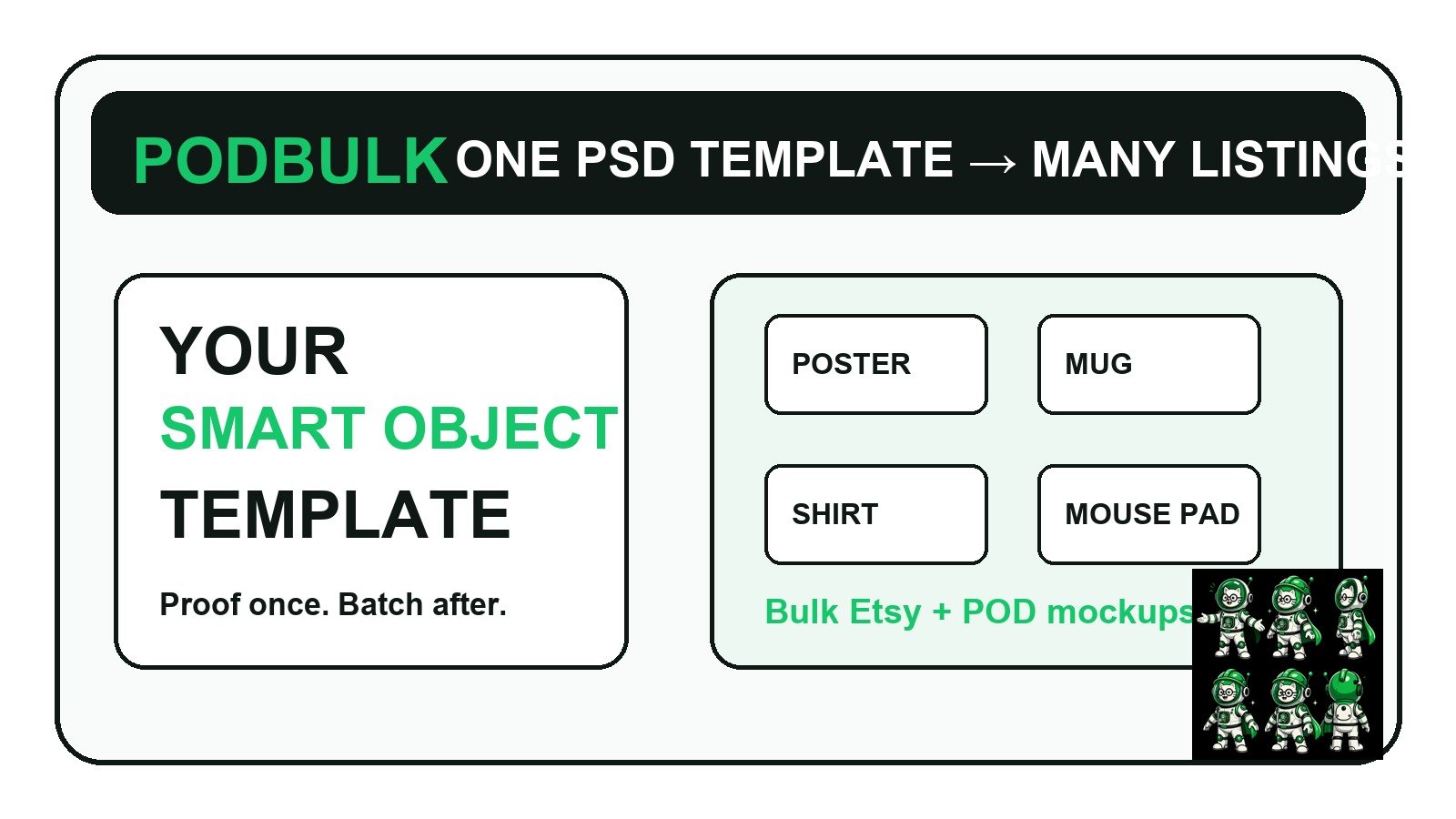
A strong Etsy POD mockup workflow is not about making one image look good. It is about making one reliable PSD template system that can produce many accurate listing images without burning you out.
Most sellers start by making mockups one at a time. That works for ten products. It gets painful at 100 products. It becomes a wall at 1,000 outputs. PodBulk is built for the middle of that problem: you bring your own compatible PSD templates and design files, then batch the repeated Smart Object replacement in the browser.
The short version
- Build one branded template style before scaling.
- Proof with difficult designs so the full batch does not multiply mistakes.
- Use Focus when one exact Smart Object layer should change.
- Use multiFocus when the same design belongs in many matching placements.
- Keep outputs organized by product, template, design and marketplace.
Why Etsy sellers need a workflow, not random mockups
Etsy shoppers scan thumbnails quickly. If your mug, poster, shirt or mouse pad mockups all use different lighting, crop styles and backgrounds, the shop can feel accidental. A repeatable PSD template system makes your store feel like a brand. It also makes production easier because each new design follows a known path.
Step 1: choose the products you actually sell
Do not build templates for every possible product. Start with the product families that matter: posters, mugs, mouse pads, shirts, tote bags, stickers or wall art. Each product needs scenes that answer buyer questions. A poster buyer wants scale, frame option and wall context. A mug buyer wants handle view, print area and lifestyle feel.
Step 2: build or buy compatible PSD templates
Your PSD template should use Smart Objects for the design placement. Name the important layers clearly. If the main target is called Mock, keep that casing. If a scene has repeated placements, use a shared prefix like mock_1, mock_2 and mock_3 so multiFocus can target the family.
If you are new to Smart Objects, start with what a Smart Object is, then read the Auto Detect, Focus and multiFocus guide.
Step 3: proof one template before the full batch
The fastest bad workflow is the one that skips proofing. Test one template with a light design, dark design, detailed design, wide design and tall design. Check the edges, scale, texture, shadows and readability on a phone. If the proof is wrong, the full batch will only make wrong files faster.
Step 4: use PodBulk for the repeated replacement
Once the proof is good, open PodBulk, add your PSD templates and design files, choose the targeting mode and process the batch. The paid workflow currently supports up to 20 PSD templates by 50 designs in one run, which can create 1,000 outputs when the files are suitable. For very heavy PSD files, smaller chunks are still smarter.
Step 5: organize outputs before listing
Mockup speed only helps if you can find the files later. Use folders like poster/room-template/design-name or filenames with product, design, template and rank. Keep master designs separate from listing images. Keep Etsy, Shopify and client proof exports separate too.
What makes a good Etsy listing image set?
A good listing set answers questions, not just fills image slots. Use a clean primary mockup, a scale image, a detail image, a variation image and any usage information the buyer needs. For digital products, show what is included. For POD products, avoid misleading scale or impossible colours.
Where PodBulk saves the most time
PodBulk saves the most time when the creative decision is already made. The PSD is approved. The design folder is ready. The target layer name is known. At that point, replacing Smart Objects manually is not creative work anymore. It is production work, and production work should be batched.
Why this helps avoid burnout
Burnout often comes from tiny repeated tasks that never feel finished. Listing creation already has enough work: title, tags, photos, description, pricing, shipping, production partner and customer questions. If mockups take all your energy, the listing never reaches the customer. A batch workflow protects the part of your day that should go to products and marketing.
2026 update: where PodBulk Vortex fits
For the workflow described in Etsy POD Mockup Workflow: Use One PSD Template System for More Listings, Vortex is the current PodBulk option for moving supported PSD rendering to the cloud. Premium users can save PSD profiles, send supported template batches to Vortex and keep the local computer available while the render runs. Use a small test batch first; strongly bent or curved Smart Objects may need the Complex engine instead.
Read the PodBulk Vortex guide. After rendering, connect resize, rename, watermark and save steps in PodBulk Workflow when you need an upload-ready folder rather than loose mockup files.
Final answer
Use one branded PSD template system, proof it carefully, then let PodBulk handle the repeated Smart Object replacement. That is how Etsy and POD sellers move from manual mockups to a repeatable production workflow without losing their shop style.
Start with PodBulk, compare your first proof batch, then continue with the PSD mockup folder organization guide, the PSD mockup quality checklist, and the 1,000 mockup workflow when you are ready to scale.
Frequently asked questions
What is an Etsy POD mockup workflow?
It is a repeatable system for turning approved designs and PSD templates into listing images, then checking, naming and organizing the outputs before upload.
Can I use my own PSD templates with PodBulk?
Yes. PodBulk is built for compatible PSD templates that use Smart Objects for the replaceable design area.
Should I batch every design immediately?
No. Proof one template and a small difficult design set first. Scale only after the output looks correct.
What is multiFocus useful for?
multiFocus can fill several Smart Object layers that share the same name prefix, which helps with multi-placement product scenes.
Does PodBulk replace listing SEO work?
No. PodBulk speeds up image production. You still need good titles, tags, descriptions, pricing and customer service.
Stop making mockups one by one
PodBulk turns your PSD templates + designs into bulk, listing-ready mockups right in your browser — no Photoshop, no install.