PodBulk vs SudoMock: Why PodBulk Wins for Most Etsy and POD Sellers
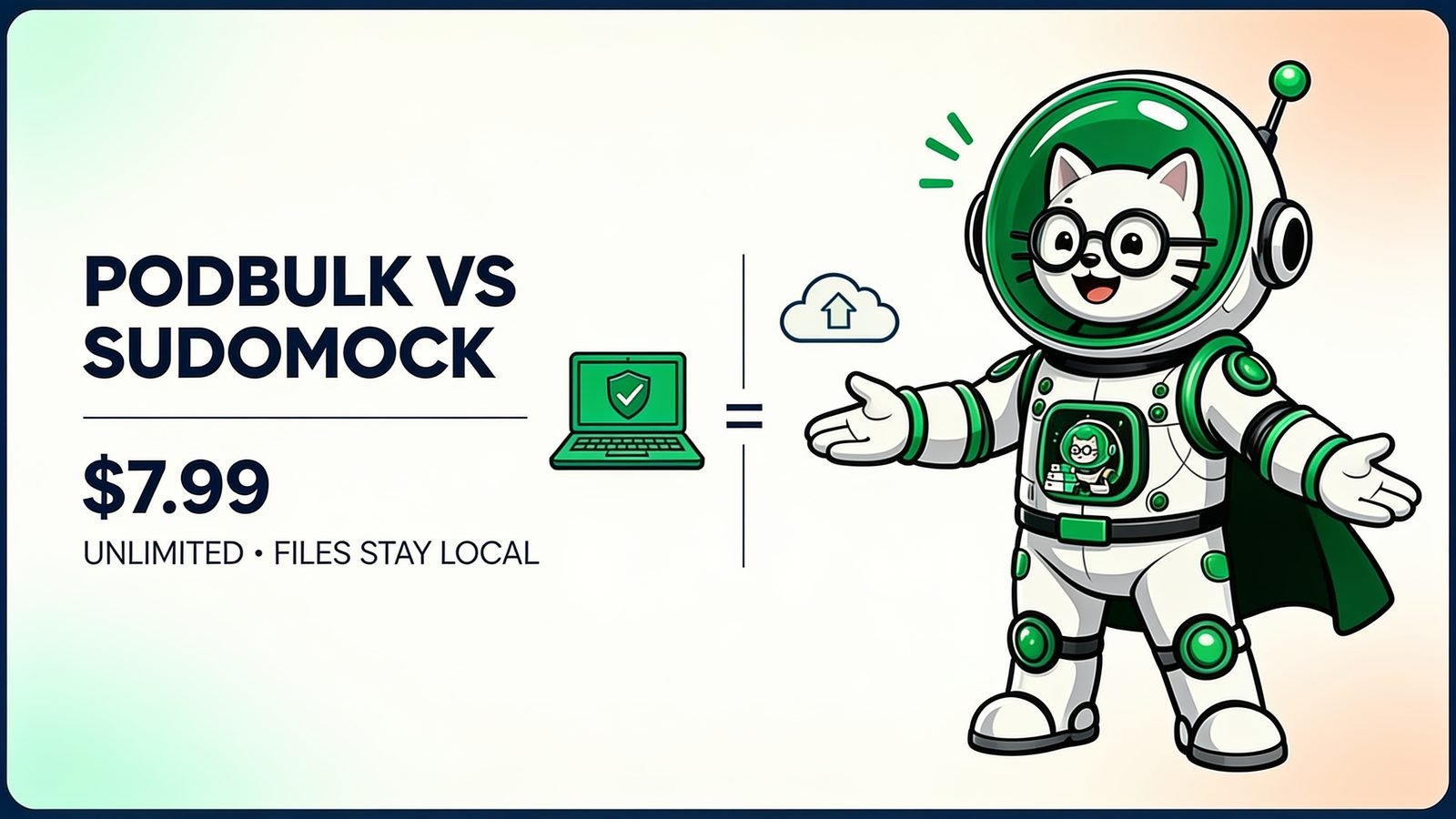
PodBulk is the better choice than SudoMock for most Etsy sellers, print-on-demand sellers, and designers who personally make product mockups. PodBulk costs $7.99 per month for unlimited use, processes source files locally in the browser, supports up to 20 PSD templates × 50 designs in one run, and includes the other bulk image tools a seller needs after rendering. SudoMock is stronger for a different job: developers who need a hosted rendering API, SDKs, webhooks, and cloud output URLs. See also the $7.99 PodBulk value breakdown for sellers using their own PSD templates.
Short verdict: if you select folders and download finished mockups yourself, choose PodBulk. If your website or application must request a render automatically after an event, choose SudoMock.
Disclosure and fact check: PodBulk publishes this comparison. PodBulk plan details were checked against its live pricing configuration, and SudoMock details were checked against SudoMock's official pricing, documentation, and bulk-rendering pages on August 25, 2026.
PodBulk vs SudoMock: the quick winner
| What matters | PodBulk | SudoMock | Better choice |
|---|---|---|---|
| Most Etsy/POD seller batches | Built for a person selecting PSD and design folders | Built around hosted rendering infrastructure | PodBulk |
| Files stay on your device | Yes | No; hosted rendering requires upload | PodBulk |
| Paid price | $7.99/month | $0.10/render PAYG or subscriptions from $25 | PodBulk for sellers |
| Monthly mockup limit | Unlimited use | Metered by funded balance or monthly plan | PodBulk |
| Largest paid run | 20 PSDs × 50 designs = 1,000 outputs | Renders submitted through dashboard/API capacity | PodBulk for one-click batches |
| Related seller image tools | Included toolkit | Rendering/API platform with separate media operations | PodBulk |
| REST API, SDKs, webhooks | No public render API | Yes | SudoMock |
| Automatic storefront rendering | Human starts the browser batch | Built for programmatic triggers | SudoMock |
The biggest difference: private local files or cloud uploads
PodBulk processes the PSD templates and design files on the user's device. The browser runs the mockup job locally, and the output is downloaded locally. There is no required PSD upload to a PodBulk render server and no hosted result URL that must remain available afterward.
SudoMock is a hosted service. Its documented workflow uploads the PSD, sends design assets to the render endpoint, and returns output through its CDN. Its current pricing table lists seven-day render retention on self-service tiers, with different behavior for custom domains and enterprise arrangements.
That makes the privacy comparison simple:
- PodBulk local-file privacy: yes. Mockup source files remain on the device during rendering.
- SudoMock local-file privacy: no. Files must reach SudoMock infrastructure for its hosted renderer to work.
This is an architecture comparison, not an accusation that SudoMock lacks security. A cloud service can use strong security controls and still require file transfer. Sellers using licensed mockups, unreleased designs, or client assets may prefer PodBulk because the source files do not need to leave their computer in the first place.
Pricing: $7.99 unlimited use changes the comparison
PodBulk's current paid plan is $7.99 per month. The pricing page states unlimited use—no monthly limits, a maximum of 20 PSDs × 50 designs per run, and maximum uploads across the other tools. Unlimited refers to monthly use; the per-run file limit and available device memory still apply.
SudoMock's current pricing page lists:
- pay as you go at $0.10 per PSD render with a $5 minimum funded balance;
- Starter from $25 per month for 5,000 renders;
- Pro from $89 per month for 25,000 renders;
- Scale from $199 per month for 50,000 renders.
| Monthly seller output | PodBulk paid plan | SudoMock published option | Important context |
|---|---|---|---|
| 1,000 mockups | $7.99 | $100 PAYG, or Starter from $25 | PodBulk can make 20 × 50 in one full run |
| 5,000 mockups | $7.99 | Starter from $25 | PodBulk requires repeated local runs; SudoMock meters hosted capacity |
| 25,000 mockups | $7.99 | Pro from $89 | SudoMock's API automation may justify the higher infrastructure price |
The fair question is not merely “which number is lower?” It is “does a person run the batch, or does software need to run it?” For a seller already operating the workflow, PodBulk's flat unlimited plan is dramatically less expensive. For an application that needs unattended requests and webhooks, SudoMock sells infrastructure PodBulk does not claim to provide.
Up to 20 PSDs and 50 designs in one PodBulk run
The paid PodBulk run limit creates a full matrix:
20 PSD templates × 50 design files = up to 1,000 generated mockups in one run.
That is a practical catalog job, not a tiny demo. A seller can use 20 scenes for 50 shirt graphics, 20 framed-art interiors for 50 posters, or 20 product templates for a 50-design collection. Because monthly use is unlimited, another controlled run can begin after the first is downloaded and checked.
Use the 1,000 PSD mockup guide for proof files, output counting, storage, and quality control. The paid plan can now fit the 20-by-50 example into one full run, although splitting unusually heavy PSDs remains sensible when the device is short on memory.
Why local browser processing can feel faster
PodBulk does not need to upload every large PSD before the job begins. There is no API authentication, request payload, webhook endpoint, remote render queue, or CDN download workflow to configure. Select the files, approve a proof, and start the batch in the browser.
Actual rendering speed depends on the computer, browser, PSD dimensions, effects, and output settings. A cloud platform can win at extreme parallel scale. But for the ordinary seller sitting in front of a computer, PodBulk removes the network and integration steps surrounding each batch. That is often the speed that matters: less setup before useful output appears.
PodBulk includes more than a mockup renderer
A mockup is rarely ready for a marketplace immediately after rendering. Images may need to be resized, cropped, converted, renamed, watermarked, upscaled, organized, or moved through a repeatable folder workflow. PodBulk brings those seller-oriented jobs into the same toolkit.
- bulk resize and crop;
- bulk format conversion;
- unlimited bulk rename on the paid plan;
- bulk watermarking;
- bulk upscale;
- QR tools;
- PodBulk Workflow and file organization.
The paid pricing configuration advertises maximum uploads across all tools. Explore the complete PodBulk image toolkit. SudoMock has valuable cloud-media features, but its central value is rendering infrastructure and integrations. PodBulk is packaged around the day-to-day files a seller personally prepares.
Complex PSDs do not automatically mean SudoMock wins
PodBulk has two practical rendering paths: a fast path for ordinary Smart Object mockups and a fuller compatibility path for more complex PSDs with multiple Smart Objects, masks, or effects. It also has three current targeting modes:
- Auto Detect for one unambiguous Smart Object or the preferred
podmocklayer; - Focus for one exact, case-sensitive Smart Object name;
- multiFocus for the same design across every Smart Object sharing a prefix ending in
_.
The Auto Detect, Focus and multiFocus guide documents hidden layers, nested folders, safe errors, and exact examples. The multiple Smart Objects guide covers front, back, label, screen, and repeated-scene structures.
SudoMock also publishes significant PSD capabilities, including multiple Smart Objects, editable text, fonts on applicable plans, and hosted high-resolution output. If a PSD depends on editable text or if software must manipulate those fields, SudoMock may be the better match. If the job is placing finished artwork into known Smart Object targets, PodBulk's local compatibility workflow is designed for exactly that production task.
No honest tool should promise perfect fidelity for every PSD ever created. Test displacement maps, linked assets, unusual filters, nested objects, fonts, and custom effects before generating hundreds of files. Keep Photoshop as a fallback for a template that only Photoshop renders correctly.
When SudoMock is genuinely the better choice
Choose SudoMock when the customer, store, or application—not a human operator—must trigger the render. Its official documentation supports:
- a REST rendering API;
- Node.js and Python SDKs;
- asynchronous jobs and webhooks;
- parallel cloud rendering by plan;
- hosted CDN output URLs;
- n8n, Zapier, Make, Shopify, and WooCommerce integration paths;
- embedded and white-label customization options.
Those are developer and platform capabilities. They matter when a personalized product preview must appear automatically after a shopper enters data, or when an internal catalog system must render without someone opening a browser batch. Paying more can be rational because the API removes human initiation.
Who should choose PodBulk?
Choose PodBulk if most of these statements are true:
- You sell on Etsy, Shopify, Amazon, eBay, or a POD marketplace.
- You already own or create PSD Smart Object mockups.
- You have folders of finished PNG or JPG designs.
- You want the files to remain on your computer.
- You prefer a predictable $7.99 monthly cost.
- You do not want a per-render charge or monthly mockup allowance.
- You want up to 20 PSDs and 50 designs in a run.
- You also need resize, rename, convert, watermark, upscale, and workflow tools.
- You want to work without Photoshop, API code, or server setup.
Final verdict: PodBulk wins for sellers; SudoMock wins for APIs
For most Etsy and print-on-demand sellers, PodBulk is the better value and the simpler workflow. It keeps files local, costs $7.99 per month for unlimited use, can combine 20 PSDs with 50 designs in one run, supports a complex-PSD compatibility route, and includes the surrounding image tools needed to prepare listings.
SudoMock is not the better default merely because it has more developer features. It is the better specialist when a business truly needs a hosted API, webhooks, integrations, editable text automation, or cloud infrastructure. Do not pay for an API architecture when your actual job is selecting two folders and downloading a batch.
Open PodBulk and test a real PSD locally, or check the current $7.99 unlimited plan. For other alternatives, visit the mockup generator comparison hub.
Frequently asked questions
Is PodBulk or SudoMock better for Etsy and POD sellers?
PodBulk is the better default for most Etsy and POD sellers who personally create mockup batches. Its $7.99 paid plan has unlimited use with no monthly render limit, supports up to 20 PSDs by 50 designs per run, keeps source files on the device, and includes related bulk image tools. SudoMock is the better fit when a developer needs a hosted API, webhooks, SDKs, or automatic storefront-triggered rendering.
How much does PodBulk cost compared with SudoMock?
PodBulk's current paid plan is $7.99 per month with unlimited use and no monthly mockup limit. SudoMock's official pricing lists $0.10 per PSD render with a $5 funding minimum, Starter from $25 for 5,000 monthly renders, Pro from $89 for 25,000, and Scale from $199 for 50,000. Verify both pricing pages because plans can change.
Which tool keeps PSD and design files private on my device?
PodBulk processes PSD templates and designs locally in the browser, so the mockup source files stay on the device. SudoMock's hosted workflow requires uploading a PSD and sending artwork to its infrastructure, then returns a hosted result. That does not mean SudoMock has no security; it means it does not provide the same local-file privacy model.
Can PodBulk generate 1,000 mockups in one run?
Yes, on the current $7.99 paid plan when the job uses the full limit of 20 PSD templates by 50 designs. That matrix equals 1,000 outputs. Unlimited use removes the monthly mockup cap, but the 20-by-50 per-run limit and the computer's available memory still apply.
Why can PodBulk be faster for a normal seller workflow?
PodBulk starts processing locally after the files are selected, without first uploading large PSDs or configuring API calls, webhooks, and result URLs. Speed still depends on the computer and PSD complexity, but ordinary human-operated batches avoid a cloud upload and integration round trip.
Can PodBulk process complex PSD mockups?
PodBulk provides a fast path for ordinary templates and a fuller compatibility path for more complex PSDs with multiple Smart Objects, masks, or effects. Its Auto Detect, Focus, and multiFocus modes target one or several Smart Objects. Every unusual PSD should still be proofed before a large batch.
When is SudoMock better than PodBulk?
SudoMock is better when mockup rendering must be called by software rather than started by a person. Its official offering includes a REST API, SDKs, webhooks, parallel cloud renders, hosted output URLs, integrations, and editable PSD text capabilities.
What other tools are included with PodBulk?
PodBulk combines PSD mockup batching with seller-oriented bulk operations such as resize, crop, convert, rename, watermark, upscale, QR tools, Workflow, and file organization. The current paid plan advertises maximum uploads across all tools and unlimited rename.
Stop making mockups one by one
PodBulk turns your PSD templates + designs into bulk, listing-ready mockups right in your browser — no Photoshop, no install.